

IVF, which is short for in vitro fertilisation, follows the same core steps at any clinic. Essentially: eggs are collected (or received from a donor) and fertilised in a lab, and then the embryo is transferred into your womb.
But at ARGC, IVF is a lot more thorough and involved than what’s standard.
So, what can you expect when doing IVF at ARGC? We’ve broken down the process below—and explained how we do things differently.
Most of the time, IVF treatment follows a standard protocol. This is a fixed, pre-determined plan of action that’s been developed from scientific research. Standard protocols are widely used in healthcare because they allow care to be delivered consistently.
Yet because they’re designed from large-scale data, they tend to represent the “average” patient. And with IVF, a one-size-fits-all model doesn’t work for everyone. That’s why we build each treatment cycle around the individual.
What that means is: we measure your body’s unique rhythms and patterns and then create a plan precisely tailored to you.
And since your body is changing all the time, we monitor you daily during treatment and adjust your plan in real time as needed. This way, we are able to optimise every factor that we can control that impacts your treatment—and give you the best chance of success.
With this approach, we’ve had the leading success rates for IVF and ICSI, for 30 years.
Yet working in this way means there’s a few more steps to the IVF process at our clinic.
Here’s what to expect when you go through IVF. We’ve noted which parts of the below are unique to ARGC.

First, your clinic needs to understand where you’re at in your fertility journey.
During your consultation at ARGC, we’ll ask you about your medical and fertility history, including any previous treatments you’ve tried. This will help us get a sense of any challenges you’ve been dealing with.
It’s helpful to send us any relevant medical records in advance, so we can review them ahead of time. Your consultation is also a good time to ask any questions you have.
Consultations with us are held online and last 45 minutes to an hour. If you have a partner, we recommend that they attend with you.
This isn’t always included in standard IVF treatment. But it’s non-negotiable for us at ARGC.
Before you start treatment, we monitor your body’s rhythms and patterns throughout a complete menstrual cycle, without you taking any medication. We measure your hormone levels at the start of the cycle, perform a pelvic ultrasound mid-cycle (closer to the time you would ovulate), and then check your hormones again later in the cycle.
This shows us your body’s unique hormone patterns and exactly when you ovulate. We also look for any factors that might be affecting your fertility, like immune issues or hormone imbalances.
We gather these insights and create what we call your “personal fertility map”. And we use it to design your treatment plan.
This step is important because it indicates what sort of medication schedule is likely to give you the best chance of success.
There’s also tests that all clinics in the UK are required to do before IVF. These include blood tests for HIV, hepatitis B and hepatitis C. Your clinic will confirm that’s needed.
Then it’s time to start your treatment cycle. In this phase, you’ll take daily medication to stimulate your ovaries to produce more eggs, so as many can be collected as possible.
There are two main ways clinics in the UK do this: either via a short or a long protocol. As the names suggest, these are different approaches that work to either a shorter (10-14 days on average) or longer (around 3-4 weeks) timeline.
Your doctor will tell you which is best for you. They’ll consider your age, hormone levels, follicle count, and medical history when making their decision.
But speaking generally, the long protocol tends to be used if you have regular periods or are younger. The short protocol may be recommended if you’re older or have fewer available eggs.
At ARGC, we offer long and short protocols but take an individualised approach. Rather than following a fixed, standard schedule for either, we monitor you daily and adjust your treatment as needed.
We also offer a natural cycle protocol. It’s a gentler approach that works with your body’s natural rhythm, using minimal stimulation medicine. We would recommend it in specific cases, for example if you’re unable to take high doses of fertility medicines. It’s something your doctor will discuss with you.

At ARGC, we’ll monitor you continuously while you’re having treatment.
During stimulation, we do daily blood tests (sometimes, twice) and scans every few days to see how your body is responding to the medicine. This way, we can monitor your hormone levels and follicle development in real time, and catch any potential issues quickly. We can then make immediate adjustments to your medication dosage if needs be.
This step is unique to us and we consider it essential. Changes happen inside your body every day. By monitoring those changes, we can make sure your body is getting exactly what it needs right now to best support follicle development.
We work in this way—continuously collecting data and adapting your plan—to give you the highest possible chance of success.
Once your eggs are developed enough, it’s time to collect them.
Timing is everything with egg collection. We monitor your follicle growth during stimulation and when they’re at the right level of development, we give what’s called a trigger shot 36 hours before collection. This “triggers” the final stage of egg maturation.
No matter what the optimal day for your collection is—whether it’s a Sunday, bank holiday, or even Christmas day—we will be open and ready for you at ARGC. We are available 365 days a year.
The collection procedure itself is generally quick and straightforward: most people go home on the same day. You’ll be sedated throughout and won’t feel any pain.
The eggs are then taken to the lab to be fertilised.
This can happen via two methods: standard IVF or ICSI (intracytoplasmic sperm injection). In the former, eggs and sperm are placed together in a petri dish. Just like in natural conception, the sperm attach to the outside of the egg—and usually, just one will make it inside.
With ICSI, an embryologist selects a single, healthy sperm and injects it directly into the egg. Your clinic may recommend this in specific situations, for example if you’re using frozen sperm or dealing with male factor infertility.
There’s another specialised technique we may offer called oocyte activation. Here, eggs are placed in a chemical solution for about 15 minutes after the ICSI injection. This “activates” the egg, triggering changes that are necessary for fertilisation to begin. Again, this is only something we would recommend in particular cases, like if ICSI hasn’t previously worked for you.
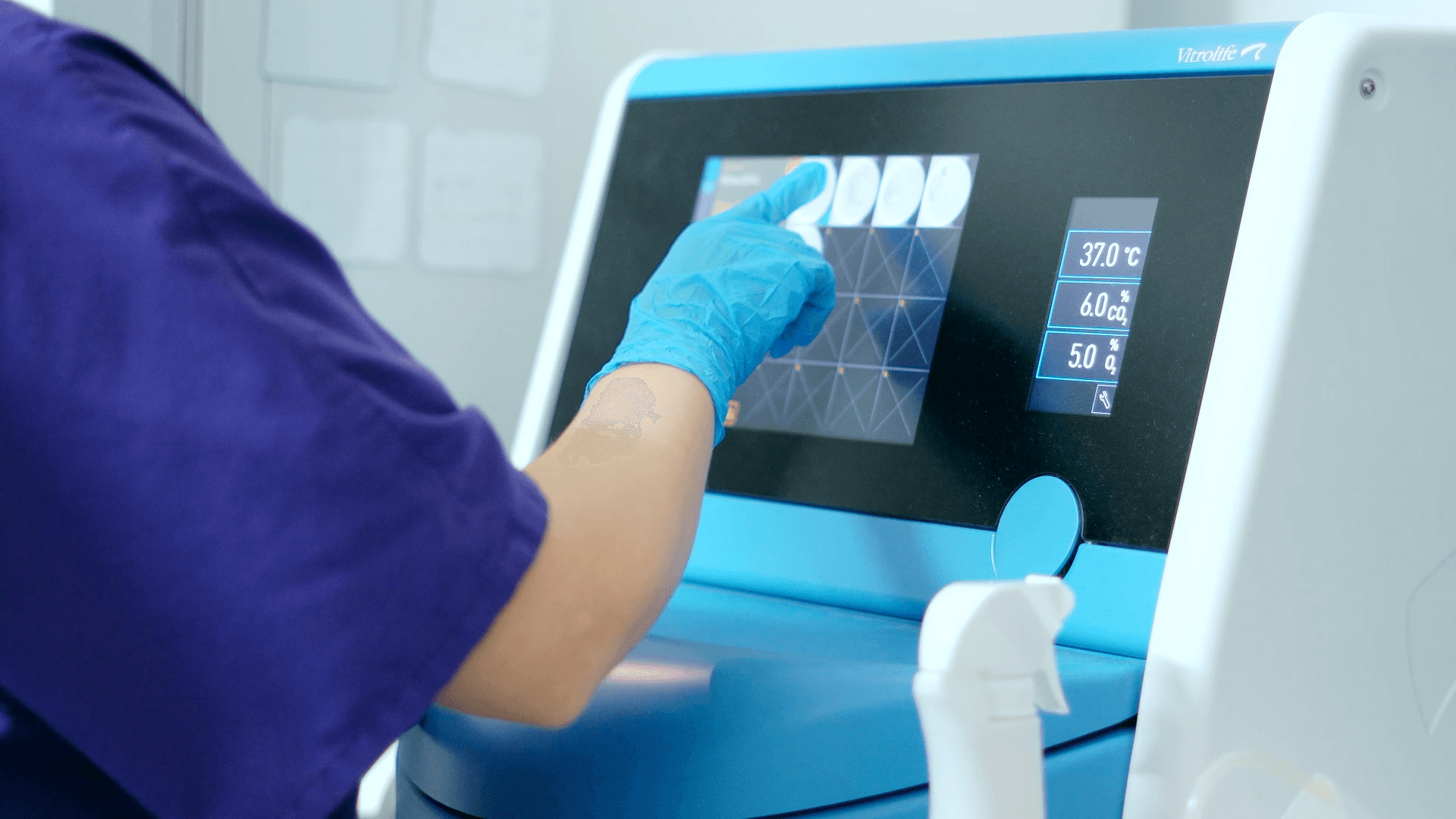
Embryos are carefully monitored in the lab once they’re fertilised. They are placed in a special incubator that’s designed to mimic the natural environment of the womb.
During this time, you’ll get daily updates from our embryology team. You’ll also have access to ASHA, our AI fertility assistant who can help answer any general questions you have.
Then it’s time to transfer the embryo(s) into your womb.
First, your clinic will select the highest quality embryo(s) for transfer. They look at how well the embryos are growing, and their cell count and quality, when making their decision.
Depending on how your embryos develop, the transfer might happen either 2-3 days or 5-6 days after fertilisation. Your clinic will confirm what’s best for you personally.
The procedure itself is gentle and will be over quickly. Your doctor will place the embryo(s) into your womb using a catheter. This usually takes around 20 minutes.
Good to know: both fresh and frozen embryos are transferred via the same procedure.

Embryo transfer is the last stage of an IVF treatment cycle. Next is what’s called the “two week wait”—the period of time between transfer and taking a pregnancy test.
Despite the name, you’ll likely wait around 10 or 12 days before testing. It depends on how many days after fertilisation you had the transfer (i.e. days 2-3 or 5-6).
At ARGC, we will monitor you throughout the wait: you’ll come in for a blood test every two days to check your progesterone levels. Plus, we’ll do a full blood count every 2-3 days to check for any other potential issues.
Progesterone is a really important hormone for pregnancy. It ensures that your womb lining is thick enough for the embryo to attach and burrow into it (this is implantation), and helps your body maintain early pregnancy. If your levels drop too low, we can spot this right away and adjust your medication schedule.
Again, post-transfer monitoring isn’t a standard part of IVF. But it allows us to make sure we are doing everything we can to support your body in providing the optimal environment for the embryo.
And then, it’s time to take a pregnancy test. This will be a blood test we’ll do in the clinic, not an at-home test—this is the most accurate way. No matter the outcome, we’ll be right there with you, guiding you through what’s next.
We’ll continue to monitor you for 12 weeks—and often longer if you’re receiving immune treatment. This isn’t a standard part of IVF treatment, but it helps us detect subtle changes that might affect your pregnancy.
If this happens, we will be here to help and support you. We’ll advise on what you should do about any medications you’re taking. You’ll also have a follow-up appointment with a doctor to go over the last cycle and discuss why it might have failed.
A failed cycle is an important source of information for us. We’ll use these learnings to adjust your treatment plan, if you would like to try again.
No two fertility journeys are the same. And if you decide to try IVF, it’s important you choose a clinic that feels right.
Our process is rigorous and intense, but it’s designed to give you the best possible chance of becoming a parent. By building your treatment around your body, and adjusting it as necessary, we can make sure it’s precisely tailored to your needs.
Wondering whether ARGC is right for you? Our advisory calls are free, no-obligation, and led by someone who can answer your specific questions about treatment, costs, and what to expect. Book a call to get started.

Monica Karpinski is a health and science writer specialising in women's health. She has previously written for Stylist, Reader's Digest, the New Statesman Media Group, and more.

 The ARGC approach to IVF