

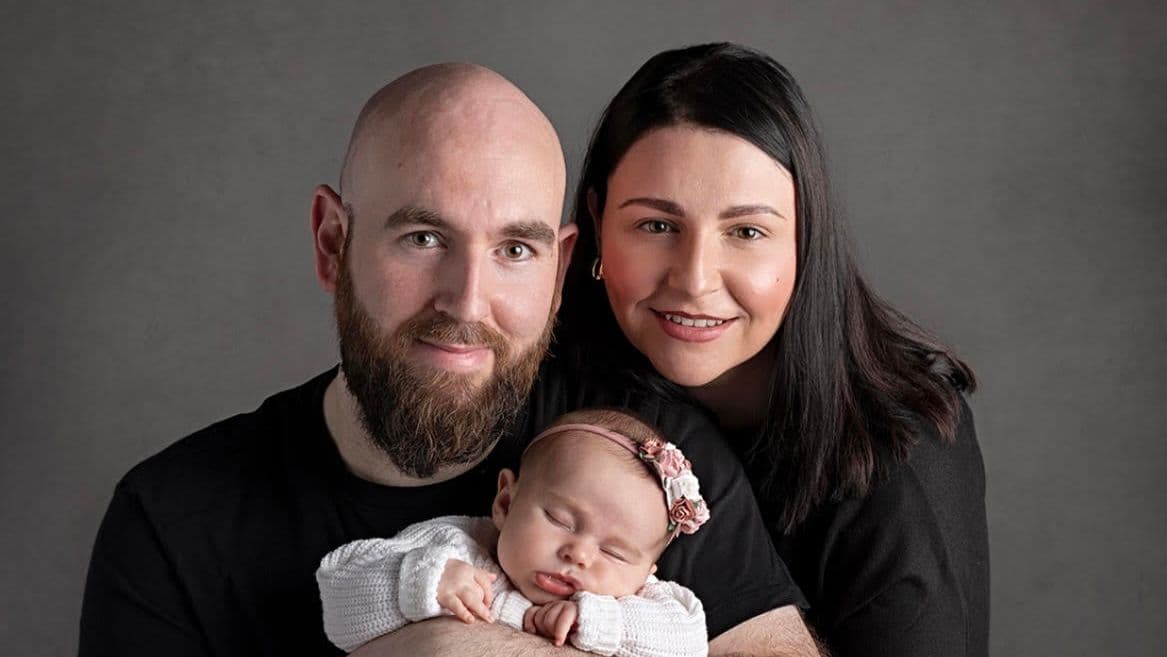
They were young and seemed healthy, yet Laura and Adam struggled to conceive naturally. After learning that Laura had PCOS and an imbalance in her immune system, they turned to ARGC for help—and soon after, their daughter was born.
When Laura and Adam got married in their early twenties, they thought having children would come easily.
No-one expected them to have any difficulty: they were young and seemed healthy. Their friends were all getting pregnant quickly. Fertility issues just weren’t something being talked about around them.
But when they started trying, nothing was happening and they weren’t sure why. Laura was frustrated and confused: her friends were getting pregnant easily, so why wasn’t she? It didn’t help that people in her life kept asking when she was going to have a baby. “It was very, very hard,” she says.
A few years down the line, during a doctor’s visit for another reason, Laura mentioned that she’d been struggling to conceive. She was sent for testing and diagnosed with PCOS, a hormonal and metabolic condition that can affect fertility.
They then decided to try IVF on the NHS. “We got pregnant twice out of three transfers, but with those two pregnancies, I miscarried very, very early,” Laura shares. “No sooner did I find out that I was pregnant, than I found out that we’d miscarried. Something in me, in my gut, was saying, ‘There’s something else going wrong here’.”
While these are vital components of the immune system, when their levels become too high, they can mistakenly treat an embryo as a foreign threat—interfering with how the body accepts and supports a developing pregnancy.
This seemed to be what was happening to Laura. Yet any relief she felt at having answers was short-lived. After delivering their results, the hospital informed them that the treatment they needed wasn’t available on the NHS.
Laura and Adam were heartbroken. “It was like somebody just dropped us into the ocean and left us, abandoned us. We just felt so lost and it was hard,” she recalls.

Worried and stressed, Laura focused her energies on finding a clinic that could help them. She came across ARGC on social media and liked the approach of tailoring IVF to the individual. She had already gone through a one-size-fits-all protocol and didn’t want to do it again.
It also helped that ARGC offered immune treatment and had high success rates. We’re pioneers in reproductive immunology in the UK: since 2002, we’ve helped many patients dealing with immune imbalances, failed cycles elsewhere, or complex fertility issues. While some see the field as an “add on”, we firmly believe in its importance.
“I knew straight away, from the moment I clicked on [ARGC] that they were the team that could help us,” Laura says.
Laura and Adam were ready to go all-in. They travelled into London from the midlands for appointments, a two-hour car trip one way. While they found the constant scans and blood tests intense—during stimulation, bloods are done daily while scans happen every 1-3 days—they tried to take each day as it came. In fact, Laura found the continuous monitoring to be reassuring. She felt like she was being looked after.
Following egg collection, they did a fresh transfer—where embryos are transferred during the same treatment cycle as egg collection—with two embryos.
And then, Laura was pregnant. “I literally couldn’t believe it,” she remembers. “All that time, 10 years, we’d waited. I said, ‘Are you joking me?’” But it was true: Laura was pregnant with twins.
Close monitoring continued throughout early pregnancy. Typically, we would do this for 12 weeks, but for patients on immune treatment we may extend it to 20-24 weeks. Laura was monitored up until week 20.
She also had an immune blood test done every three weeks, which she found very reassuring. These tests are done if we suspect there are any immune factors affecting your fertility. During early pregnancy, they help us to track your immune response and see how your body is responding to treatment.
Then, at nine weeks, Laura lost one of the babies. “It was a scary moment because you start worrying about the other one,” she says. Laura was afraid that something else would go wrong and that the unthinkable would happen: she would lose both twins.
Yet a scan the following day showed that their other baby was perfectly healthy: they were going to have a baby girl. Laura was relieved but still grieving her loss. It helped to focus on their healthy baby. “I felt, ‘Right, I’m still pregnant with this one, let’s just do everything [that we can] to get to the end’.”

Soon enough, Aria Rose was born. Today, she is two years old. She loves books, knows the names of all the colours, and can count to ten.
“When Aria was finally here and she was placed in our arms, I think for that first week, I just kept crying,” says Laura. “I said, ‘Gosh, I never thought I would see you. I never thought I’d have you. And I’m so grateful to the clinic for bringing you into our lives’.
“We knew that my body would never accept a pregnancy while my natural killer cells were raised. And ARGC took complete control of it.”
She was struck by the feeling of wanting to relive the entire experience: even the bad days. “I would do it all over again a million times.”
Wondering whether ARGC is right for you? Our advisory calls are free, no-obligation, and led by someone who can answer your specific questions about treatment, costs, and what to expect. Book a call to get started.

Monica Karpinski is a health and science writer specialising in women's health. She has previously written for Stylist, Reader's Digest, the New Statesman Media Group, and more.

 Seeking answers