


Written by
Monica Karpinski

Medically reviewed by
Kelda Gould
Fertility Nurse • BN in Adult Nursing
 What are ovarian follicles?What happens to ovarian follicles during IVF?What is a normal follicle count?What is a ‘good’ number of follicles for IVF?What if I have a lower follicle count?What if my follicle count is higher than normal?How big do follicles need to be for IVF?Can follicles be too big for IVF?Can follicles be empty?Your IVF cycle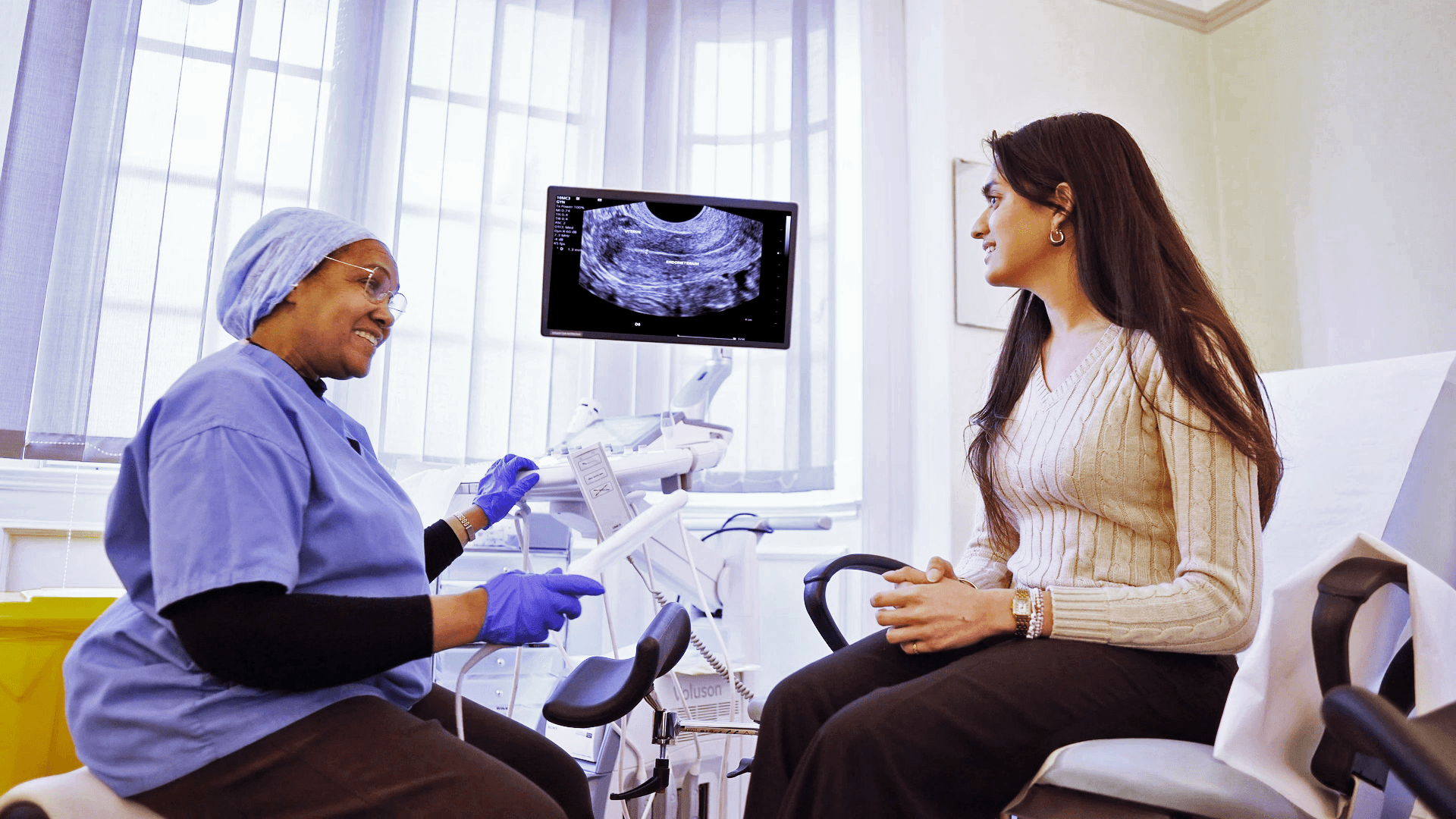
It’s a common question about IVF treatment: how many follicles is enough? And unfortunately, the answer isn’t clear-cut.
There’s no specific number: ultimately, you only need one egg to become pregnant. Though having more follicles means there’s a chance to retrieve more eggs, which does generally increase your odds. But egg quality also plays a role: you could have a ‘good’ amount of follicles but poorer quality eggs.
Yet your follicle count does matter. It tells us about your ovarian reserve (how many eggs you have in your ovaries) and allows us to create a treatment plan that best sets you up for success. Here’s what you need to know.
They are small, fluid-filled sacs in the ovaries that eggs grow in. Each follicle has one immature egg. As the eggs develop and get bigger, so does the follicle.
When it’s big enough to be seen on an ultrasound, it’s called an antral follicle. And your antral follicle count indicates your ovarian reserve.
Follicles rely on specific hormones to grow, but there’s a limited supply of them available throughout a natural menstrual cycle. So, during each cycle, several follicles compete for growth—and usually, just one comes out on top. This dominant follicle develops to maturity and releases its egg.
Good to know: follicles are visible when they are between 2-10mm long.
Things are a little different with IVF. Before egg collection, we use medicine (the hormones FSH and LH) to stimulate the ovaries. This means that the hormones the follicles need to grow are no longer in short supply. So, multiple follicles—and eggs—can develop.
What’s ‘normal’ can vary from person-to-person. The scale that’s generally used is based on averages. It goes like this:
Remember: it may still be possible to get pregnant with a lower count. Your follicle count is just one piece of information about your fertility that we consider when creating your treatment plan.
Average follicle count by age Your follicle count naturally declines with age. Researchers are still looking into the rate at which it drops.
But to get an idea of how your count might change over time, we can look to estimations from studies that have been done:
Good to know: PMOS is the new name for PCOS (polycystic ovarian syndrome). It’s a metabolic and hormonal condition that can affect fertility.
What’s ‘good’ can be different for everyone. The ‘normal’ follicle count that’s used is based on averages. Your numbers might be higher or lower than average but still be ‘normal’ (what we would expect) for you.
There’s no set minimum number of follicles you must have to do IVF. Even if you only have a few follicles, our team at ARGC would adapt their approach and create a personalised treatment plan for you. We would consult with you and explore all available options.
Having a follicle count of four or lower doesn’t necessarily mean that you can’t do IVF. It just means that your ovaries might need extra support to produce eggs during the stimulation phase.
We create a tailored protocol for every single patient here at ARGC. And if you had a lower count, your plan would include additional support to help your ovaries function better and improve egg development. For example, we might adjust the dosage of your stimulation medicines or suggest supportive treatments, such as growth hormone. This may support the ovaries and increase egg numbers.
Another approach called dual stimulation might also be appropriate. Here, you have two rounds of ovarian stimulation and egg collection within the same cycle. Traditional IVF has just the one stimulation during the follicular phase of the cycle, but dual stimulation adds in another one 2-5 days after your first egg collection. This maximises your chance to get quality eggs within a single cycle.
Though dual stimulation comes with a potential risk of more bloating and discomfort, since there are more medicines being used. And it might also be more emotionally demanding for some people, since it goes on for longer and is a bit more physically intense than a standard cycle.
We monitor your progress daily (sometimes, twice per day) during stimulation, so we can see how your body is responding to treatment in real time. This way, we can see if your protocol is working as we want it to or if we need to make any adjustments.
But what if you have more follicles than normal? Generally, this is considered positive because it suggests we might be able to collect more eggs.
Yet it can come with an increased risk of ovarian hyperstimulation syndrome (OHSS). This is when the ovaries react too strongly to stimulation and become larger than usual. Extra follicles can make your ovaries much more sensitive to fertility medicines.
Because of the continuous monitoring we do at ARGC, we can keep an eye on your symptoms and hormone levels—and make any adjustments needed to lower your OHSS risk.
Having a high follicle count is common in people with PMOS.
Generally, we would want your follicles to be 16-22mm for you to receive your trigger injection. This is a hormonal medication that brings the follicle into the final stage of development, so the egg is at the perfect level of maturity when it’s time to collect it.
During an IVF cycle, follicles would typically grow about 1.7mm per day.
There’s no specific size follicles need to be before starting IVF.
When follicles grow larger than 16-22mm during an IVF cycle, they are more likely to contain eggs that have developed beyond the optimal level. You could think of them as being overripe.
These eggs have a much lower chance of being fertilised successfully. And if fertilisation does happen, there’s a higher risk of abnormal development.
Because of the continuous monitoring that we do at ARGC, we can avoid this problem. By following the development of your follicles closely, we can make sure that we collect your eggs at precisely the right time. That’s why we’re open 365 days a year, including Christmas Day: if it’s the right time for collection, we’ll be open and ready.
What if your follicles are larger than normal before starting treatment? Then these would be classed as cysts.
Cysts are also fluid-filled sacs in the ovaries, but they don’t contain any eggs. Large cysts can interfere with your treatment: they can disrupt your hormone levels or take up valuable space in your ovaries, preventing healthy follicles from growing. Your clinician will discuss what’s best if you have an ovarian cyst.
It’s rare, but yes—follicles can sometimes be empty. The name for this is empty follicle syndrome (EFS).
We don’t know exactly why it happens and it’s not something that can be predicted. But EFS can be a possible complication of fertility treatments like IVF and egg freezing. Studies estimate that 0.045-7% of people doing IVF experience it.
If this happens to you, we will be on hand to support and guide you through what’s next. It doesn’t necessarily mean that IVF won’t be successful in future.
Whether you’re in the thick of an IVF cycle or are about to start your journey, there’s probably a million questions running through your mind right now. Like: what will my next steps look like, and what are my odds of success?
There are no guarantees in fertility treatment. But our unique and thorough approach at ARGC is designed to give you the best possible chance of becoming a parent.
We create your IVF treatment plan based on what your body is telling us and monitor how you are reacting daily. We can then make any adjustments needed in real-time. This way, we can control all the controllables and tend to any potential issues instantly.
Wondering whether ARGC is right for you? Our advisory calls are free, no-obligation, and led by someone who can answer your specific questions about treatment, costs, and what to expect. Book a call to get started.
Fertility Nurse • BN in Adult Nursing
Kelda Gould is a Registered Nurse specialising in fertility care. She holds a degree in Biochemistry and has over a decade of clinical experience spanning general nursing, outpatients, first response, and fertility care.
